Showing posts with label politics. Show all posts

Monday, 24 August 2015

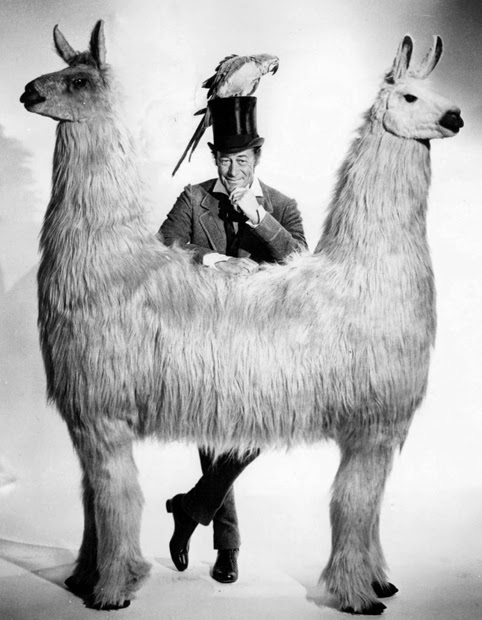
The Pushmi-pullyu, and other fantastic beasts

Putting aside specific policies for the moment, the argument of the centrists (or moderates, or Blairites, or sensible ones, or right of the party, or whatever particular phrase you want) to those on the left (or hard left, or Bennites, or Trotskyists, or morons, or whatever particular phrase you want) has been that if they want to see any part of their principles enacted by a government, they have to stop campaigning for what they actually believe in, and start campaigning for a position close to "the centre ground", where the bulk of voters are.

An addition to this argument, perhaps to sweeten the pill, is that once a centre-left party has got into government, it can start to shift the centre ground leftwards. The LabourList article of Luke Akehurst's I looked at last time gives this argument:

"My vision for the country I’d like to live in is I know, somewhat to the left of most voters, but I hope not so far to their left that they couldn’t gradually be persuaded of it through incremental evidence of successful governments"

This is what I call the push argument - that you get into power, and then start pushing the centre ground to the left by implementing policies just slightly to the left of centre.

An alternative view is held by some on the left. This is that it isn't right to compromise on any of the positions, not (or, perhaps, not just) because of a moral belief against compromising, but because they believe by doing so, they can get more of their policies implemented more quickly. Their argument is that by arguing forcefully for their policies, they can begin to move the centre ground towards them.

This is what I call the pull argument - that power is at the end of the process, not the start, but that throughout you will be pulling the centre ground to the left by causing whoever is in power to compromise their position, and implement more leftwing policies to prevent the draining of their voters away.

It can be seen that, in an ideal world, these positions can be complementary - the crazy idealists provide a tension towards the left, while the sensible pragmatists get into power and implement slightly leftish policies to try to reduce this tension.

(Naturally, a similar argument would be taking place on the right, so the centre is under tension from both sides.)

In fact, this process can be seen most clearly in countries which use proportional representation - with the added benefit of the crazy idealists and sensible pragmatists having relatively open negotiations on the policies to be implemented if they are forming a government.

However, we don't have PR, as you may have noticed. Thus we have the Labour Party, a very broad church, which includes people from both the push and the pull positions. For a long period, the push side has been ascendant, arguably since the purge of Militant.

(For the avoidance of doubt, no, I'm not saying Militant were the pull side. They were genuine entryists.)

However, up until the election of Blair, the usual push and pull tension carried on. Blair seemed like a continuation of the same, but instead of the usual way of reducing tension (that of making some compromises) he took a different path - he started to reorganise the party to remove the ability of the pull side to create any tension.

Hence the steady removal of democratic methods of holding the leadership to account, the hobbling of routes for the grassroots to direct policy, the change of national conference to a rally, and so on. In this way, tension couldn't grow from the pull side, as they had no way of being able to push their point of view - the democratic structures were removed.

So what happened? Membership fell. New parties were started, but failed. A purge without a purge happened - as the pull position came to see they could not influence the party, they naturally began to leave, thinking "why pay to be a member of a democratic socialist party which doesn't seem to want to be socialist or democratic?"

This isn't to say these people disappeared. Instead, activists of the pull position ended up finding other structures to work within. This could be: a single issue campaign, such as UK Uncut; a broader opposition to austerity, such as the People's Assembly; trade unions; smaller left parties, such as Left Unity or the Greens; or even a very focussed party, such as the National Health Action party.

While these groups did have some effect (the issue of tax avoidance was forced on to the mainstream political agenda by UK Uncut, for example) they were all hamstrung by their separation from the party political process, and by the British electoral system. So, for example, the People's Assembly could have huge meetings, but there was no-one for them to vote for that could implement their agenda. The National Health Action party could raise awareness, but people don't vote on just that one issue.

In other words, the pull position left, so there was no tension on the push position to bring them to the, uh, left. This would seem to be good for them - they could concentrate on winning votes in the centre.

Except...

Without the tension from the left, the push position could go further right, reducing the difference between them and the main opposition. After all, getting into power was the important thing - without it, no policies could be implemented. But the centre wasn't, and isn't, fixed. And the pull side on the right still existed, bringing their push side further to the right.

So the push side on the left keeps edging to the right, and the push side on the right keeps going to the right, and we end up with a Labour leadership who won't defend tax credits, who won't vote against making poor people poorer.

The leadership election, particularly following the changes made by Miliband, is one of the few democratic ways remaining for views different to the current leadership (and central party structure) to be expressed. The easy extension of the franchise to registered supporters was originally supported by the push side as they made the mistake of thinking that the people they crafted policies to attract were the same sort of people who would sign up, or join a political party.

They won't make the same mistake again. This is the opportunity for the pull side to actually exert some pressure, some balance. Even if the only thing Corbyn does is help rebuild the democratic structures of the party, he will have left a party better able to make genuine positive changes in the country.

But I don't think that is all he will do. I think he will actually provide a better electoral position for Labour than his opponents, and that is what my next post is about.

Friday, 31 July 2015

Politicians are all the same - except the ones that aren't

We've all heard, whether on the doorstep, on tv, or online, that politicians are all the same. It's not a bad shorthand, to be honest - general elections became about winning over a few thousand swing voters in a small number of constituencies, and naturally the two main parties began to adopt similar styles to try to attract them.

But that isn't the whole story. Remember Clegg-mania? Before the coalition, the Liberal Democrats had the freedom to be different. No-one, not even they, believed they were going to be in government any time soon (a hung parliament was considered a remote possibility) and so they didn't have to chase that few thousand voters - they could just be themselves instead, and it won them seats.

And then there's UKIP. They have traded extensively, and effectively, on not being like the rest. They're the authentic voice of the people, the only ones not in the Westminster bubble, not a part of the establishment, and so on. Most of these claims are absolute rubbish, but they are perceived as true, which is just as important.

Labour and the Tories, however, are seen as being pretty much the same. It's an understandable position - when one party announces they will follow the same spending plans as the other (as Labour did before 1997, and the Conservatives did in 2007), it's clear there is at least some similarity there. When you add the more recent capitulation in the argument about the causes of the government deficit and debt by Labour, leaving both sides apparently agreeing on the cause, and the solution, only differing on the details (pace, timing, marginal differences in scale of the cuts) it looks like they are more alike than not.

Don't get me wrong, I think an Ed Miliband led government would have been better for the country than this David Cameron led one, but it is easy to see how the vast majority of the electorate, who have only a passing interest in politics at election time (or no interest at all, given the number of non-voters) could think there isn't much difference.

The thing is, this is a product of the tactic of chasing the few thousand swing voters, and I no longer think that tactic is valid, certainly not for Labour. Targeting a few thousand swing voters in England is not going to win back the hundreds of thousands of voters we need in Scotland. Sounding like the Tories is not going to win back the disaffected "none of the above" voters in the north of England, many of whom voted UKIP. And if we can't keep hold of, or win back, those voters, the votes of a few thousand swing voters in the Midlands and South of England are irrelevant.

The thousands of swing voters tactic only works when the two parties are close in terms of seats. The brutal truth is that, having tried that tactic again last time, we are now over one hundred seats behind the conservatives. That doesn't call for a tactic designed to shift ten or twenty seats - it calls for a step change. It calls, in fact, for an attempt to fundamentally shift the parameters of the debate, much as the SNP managed in Scotland, much as UKIP are starting to do across England.

We're in a time of flux, and we need to win votes across the entire UK - in Scotland, to regain what we have lost, in northern England and Wales, to keep what we have, and in the Midlands and the South of England, to get back to power. The way to win those votes? By showing that we're different from the Tories. By showing that we don't think people should be criminalised for being poor, punished for being on benefits, or sanctioned for being sick. By showing that we do believe in investing in our young people, in our infrastructure, and in our country. By showing that when it comes down to choosing between the rich or them, we're on their side.

In short, by being Labour, by emphasising our differences rather than diminishing them, and, yes, by making the case for our positions, even when the electorate (currently) disagrees.

Sunday, 17 May 2009

Disconnection (Part 4)

This is the hardest post I've had to make in this series.

Over the past few days, I've been able to write almost as an observer, discussing what I think is going wrong, but without it really affecting me. Yes, I've managed to whip myself up into the odd bit of righteous anger, but that's about it.

This post is different though. This one is personal. This is about my own disconnect.

Two years ago, I wrote a lament for English socialism. In it, I told of my sorrow that what was left of socialism in the Labour Party couldn't even mount enough of a challenge to Gordon Brown to make him face an election rather than a coronation.

But I didn't leave the party. To do so would have been unthinkable. This is the Labour Party, for heaven's sake. This is the party of Keir Hardie, of Nye Bevan, of Tony Benn. They are owed my loyalty. They demand my loyalty.

And so I resigned myself to forever being disappointed in what the Labour Party did, of making steady compromises with myself to continue voting for them, telling myself that at least they weren't as bad as the Tories.

But things just got worse. After an impressive start, the Brown government started to fall apart, in style as much as substance - and this was before the banking collapse. Last year, I wrote a series of posts about the Brown government, including whether I could vote for Labour again, and what I thought was wrong with politics. And ultimately, I copped out on deciding whether I would vote for them again - but I clearly stated I could never vote for another party:

I am a tribal animal. It is a terrible flaw, but there you go. And my tribe is Labour. I am Labour. Always will be. The Liberal Democrats are inconsequential, the Tories beyond the pale. Neither could ever get my vote.


I was so sure of my commitment, of my connection to Labour, to my tribe. But...

I suppose deep down inside, I wanted to believe that some of the people at the top of the Labour Party were like me. They too had had to compromise remorselessly, steadily moving away from what they believed in their heart to something that would get them elected, elected so they could achieve at least some good.

But then came the financial crisis. When the Telegraph is calling for bank nationalisations, but the Labour government is resisting, you know something has gone very wrong with the world. To the surprise of nobody but me, it turns out it really wasn't a government of revolutionaries reluctantly turned bureaucrats. The lines they had been peddling about the superiority of the market, about its magical efficiency, about how it should be trusted, they really believed them.

The financial crisis shattered the last of my dearly held illusions about the Labour government. Once upon a time, I could believe in their financial competence, rather than them just being the beneficiaries of blind luck and bad decisions made in America. Once upon a time, I could believe that deep down inside, they believed in the same things as me. Once upon a time, I could believe they wanted to change the world.

But once upon a time ended.

And so my certainty that I was Labour through and through, tribal to the end, has been shaken. And, finally, slowly, it has collapsed.

It's so hard for me to express the pain this causes me. I suspect it is like a priest losing his faith - the one clear, definite, fixed point of his life has been destroyed, the one certainty he could cling to no matter what, the defining part of who he is is gone.

But it is worse than that. Because this collapse in my belief also means that now, finally, I can think about voting for someone else. It feels like I am betraying a dear friend, that I am cheating on a spouse, that I am lying to my parents.

The only thing I can point to, the only experience that this feels close to, is the empty, icy-cold feeling inside when your lover leaves you, when the person you had shaped your life around shrugs her shoulders and walks away. It sounds melodramatic, but the hollow devastation is all I can compare it to. But thinking I can vote for someone else means I am also betraying her, that I am the one in the wrong.

Betrayal is the only word I can use, the only one that seems to get over the shock and hurt I feel at where the party has gone, and the shame I feel myself for thinking of going elsewhere.

And I tell myself I shouldn't feel this way, that it may once have been the party of Hardie, Bevan and Benn, but that it isn't anymore. That the party moved away from me, not the other way round. I tell myself this, but it doesn't really help.

I'm grieving for the party as it used to be.

I'm not the first to feel like this. The Labour Party has been leaking members for years. Always I felt they were making a mistake, that sure, not everything was perfect, but that's what politics is all about. And then my father left the party. Secretly I believed he'd end up going back, that he couldn't possibly turn his back on the party.

But now I am seeing more people who have been committed to the party for a lifetime leaving, quietly, unobtrusively, sadly. I know of people who have been lifelong supporters and members, people who have been councillors for decades, people who have devoted a good portion of their lives to the party, simply slipping away.

These are not people who would make a fuss about it - they still have too much respect for what the party used to be to do that. But when we meet each other, then we can share our private grief. We can talk about what used to be, what we still believe, and what we wish would change.

And all this before the revelations on MPs expenses. That will drive people further away. Further away from all parties, but I can't help but feel that Labour will suffer most.

Because, regardless of the truth of the matter, many traditional Labour voters, people like me, would always have expected Tories to be out for themselves, out to get every penny out of us that they could. But not our MPs, not Labour people, surely? But their venality has been lain bare, the dramatic difference in lifestyle they demanded between how we live, and how they do. And they will suffer.

I feel sorry for the honest MPs out there, the ones who have only claimed what they must, those who claimed little. Those who didn't take advantage of the system, regardless of what the rules were. Because now they are tarred with the same brush. Already politicians were viewed as untrustworthy, and now they are viewed as greedy, venal, criminal. A plague on all their houses, primary and secondary.

And so, this is the final disconnect. A personal disconnect. One I have found very hard to write about. Because my party has betrayed me, in thoughts, in words, in deeds. And I have betrayed my party, in my mind if nowhere else yet.

I can't forgive the party. It remains to be seen if I can forgive myself.

Wednesday, 13 May 2009

Disconnection (Part 2)

The biggest disconnect in our society now is surely the gaping chasm between the richest and the poorest. During the premiership of Margaret Thatcher, income inequality increased massively in the UK. The old post-war consensus was shattered, and the result was a society that went through dramatic upheavals and pain, in a way that is still seared onto the psyche of anyone who was around in that period.

And it is these upheavals that are important. Across countries, there is a broad correlation between higher levels of income inequality and higher levels of property crime, and murder. Societies which are more unequal are more dangerous.

I believe that what this shows is that these societies begin to fall apart, that different sections of that society become disconnected from each other. Because of this process, sections of society begin to psychologically and physically separate themselves. The poorest become chavs, the richest become fat cats, and both groups hold the other in contempt. In this way, the process accelerates.

So you would hope that a Labour government, one committed to reducing inequality, and producing a fairer society, would have begun the work of reversing the changes of the long Tory government of the 80s and 90s. But it turns out, they didn't. In fact, the levels of inequality got worse.

Income inequality is now greater than at any time since 1961.

Or, to put it another way, income inequality is at its highest level since records began.

So, society has become more unequal. Combined with this, it appears that social mobility, how easy it is for someone to rise up through society, or indeed to fall, hasn't changed since 1970. And this low level of social mobility is amongst the worst in any advanced nation.

If you're born poor, you're likely to stay poor. And with the income of the lowest 10% actually falling in real terms since 2005, you're likely to get poorer.

This can't be how we want our society to be, can it? Surely a world where the bottom 10% of society have an income of £147 a week, while the top 10% make do with £1,033 a week isn't right? When the poorest 20% see their income fall by 2.6% at the same time as the richest 20% see theirs rise by 3.3%, something must be wrong?

I'm sorry to step away from the gentle cultured arguments about the effect of economic strategies, to slip into the language of black and white, right and wrong. But this is a simple binary matter, it is a matter of right and wrong. There comes a point when the impact of the economic choices we make cease to be a matter for gentle discussion over brandy and cigars, and become a bigger issue, a more important issue. There comes a point where these decisions become moral decisions, because these arguments start to affect the very lives people get to live.

When the one of the best indicators of a child's future social position, wealth, educational attainment, health, longevity and is the amount of money their parents' earn, something is wrong.

Recently, Harriet Harman launched a new equalities bill. She said that as women in general lived longer than men, it showed something was wrong that the poorest women died earlier than the richest men - and so we had to work for equal pay across the genders. This is a laudable aim, but seems to be missing the point entirely - the problem is that you will die earlier if you are poor. The money you earn decides how long you will live.

Yes, this is the language of class warfare. But the casualties are all on one side.

(To be fair, also in this bill are proposals to impose on public authorities a duty to work to reduce class inequalities. But this will only affect public authorities, leaving the rest of society to get on with the work of increasing inequality. The measures are too weak, too little, and too late.)

And yet we all seem to try very hard not to acknowledge that, turning our heads, averting our gaze, closing our eyes. We want to believe that sop to middle class sensibilities that we live in a era of 'equality of opportunity', a meaningless phrase that the statistics on social mobility to be a lie. Some of us pretend we live in a meritocracy, but isn't it odd that merit seems to be hereditary?

We used to have a political party that would point this out. We used to have a party that wouldn't help everyone ignore the effects economic policy was having on the most vulnerable. We used to have a party that would have shouted from the rooftops about inequality rising to such obscene levels. We used to.

And that is the disconnect I want to talk about tomorrow.

Tuesday, 12 May 2009

Disconnection (Part 1)

I'm worried. Worried about all of us, worried about the path we are on, worried about where we will end up. And I'm worried that no-one else seems to be worried.

Firstly, I'm worried about the police. The aftermath of the G20 riots has been raked over all over the media by now, but without seeming to get to the core of the problem.

It seems obvious by now that at least one police officer paid a contributory part in the death of Ian Tomlinson. Numerous others at best failed to prevent a criminal assault, and at worst were complicit in an attempt to hide it.

But focusing only on this one horrendous crime threatens to make us overlook the more widespread problems. I've already written about the threat to civil liberties in the UK that some police tactics have become.

When police are surveilling political protesters and journalists, using pychological warfare techniques on protesters, and recruiting informers in protest groups a reasonable person may begin to suspect they are going too far. But when police arrest over a hundred protesters before they protest it becomes clear they are.

And when the protesters are released without charge, but with excessive bail conditions, it becomes... worrying. (Interestingly, the bail conditions said those arrested couldn't communicate with each other, either directly or indirectly. Which their lawyers advised them meant they couldn't talk to the press about it, either, as that could count as indirect communication.)

But it's not just these techniques that are the problem, it's also the justifications that are rolled out by the talking heads of the police. As well as the touchstone claim of fighting terrorism, they talk about how this is just how policing should be, that they know best how to do the job, that we should just leave them to it.

And it is the point of view of view betrayed by this attitude, that the police are somehow apart from society, that is the real problem. Because when the police start to see themselves as separate from society, society starts to view the police the same way - as heavy-handed, as authoritarian, as the enemy.

That can't be good.

But the police are not alone in seeing themselves as somehow disconnected from the rest of society. There is another group that appears to see themselves as above it.

National politicians have given the impression of being aloof from society for what seems like a long time now. By its very nature, politics tends to be clannish, but that tendency appears to have grown in recent years to include politicians of all parties in one over-arching group, the Westminster Village if you like.

Part of this is natural. Parliament is an exclusive club, and members of it have much in common with each other. But the most insidious thing they have in common is that they, and they alone, have control over how much they are all paid. Recent revelations on expenses suggest their general opinion is it's not enough.

MPs have been wary of rousing public opinion by increasing their basic salary. But they have been more than happy to vote for more and more generous, and lax, expenses allocations. They have used this as a roundabout way of getting more money into their pockets.

This attitude seems to have led to our MPs viewing expenses as their right, as a system to be abused to increase their take home pay. They developed a profoundly different way of looking at their expenses system, at their pay, at their job than any of the rest of us are able to do with ours.

But it is not only in their venality that our politicians stand apart. There is often talk of a Westminster Village, of an insular grouping of politicians, excluding the rest of the world. But this is not just the natural process whereby members of a group begin to identify with the group first. Part of it is deliberate.

There has been a move over recent years, pushed by the public, to have full time politicians, people dedicated solely to Getting Things Done once elected, people who aren't distracted by anything else. Hence the attacks on MPs having second jobs, and so on. But the laudable aim of having committed politicians has had an undesirable side-effect.

Because when we start to demand politicians treat their work 'as a real job', well, they start to do so. They start to expect promotions, a clear career path. They start to turn the role into a profession. And the things with professions is that they are designed to exclude people who don't meet the entry requirements.

And so we get Special Advisers who rise to the highest ranks of government without ever having to step outside of the Westminster Village from the start of their career. We get career politicians, who start off working for a political party, then get put up in a nice safe seat, then settle down on the backbenches to wait for a call to some junior government post.

I've seen this happen in the Labour Party. There was much hard work done to professionalise the party machine, the central party itself. And, of course, once you have the professionals running the party, it's obvious that they know best what should be done. So take policy making away from the party members. Make the party conference an empty talking shop, stop it passing motions that you don't want. Control the party from the top - because the professionals are in charge, and they know what is best.

The obvious end result of this cronyism and insular attitude is typified by the current fuss over Georgia Gould. Just 22, she is the hot favourite to be selected in Erith and Thamesmead, a nice, safe Labour seat. Her qualifications for this role seems to be graduating from Oxford, and studying for a Masters at the LSE. And, of course, her experience gained from a part-time job for Tony Blair's Faith Foundation.

You may assume that for someone so young to get to work for the Faith Foundation, she must show some stellar ability. Possibly. I don't know the girl, I couldn't say. But some may suspect she landed the job because she is the daughter of Blair's old friend, and Labour Party pollster, Lord Gould.

Politics isn't about professionalism. This may seem heretical, but it isn't. Do I want the delivery of public policy to be professional? Absolutely - and that's precisely why we have a civil service. Their entire reason for existing is to provide a trained, educated, professional group of people to carry out whatever policies a government chooses. They need to be professional. Politicians need to be inspirational.

By demanding professionalism from our politicians, we've created a situation where they practically have to see themselves as apart from the rest of us. We have created the sense of disconnect between us and them. They are no longer the brightest and best of us, the people we want to represent us, to lead us. They are an external other, a group who imposes their will upon us, a group that seems more and more similar to each other, regardless of the party colours they wear.

The disconnect of politicians, and of police, from the rest of us are just two small examples of a fracturing society, though. There is a much bigger problem out there, one that affects us all. And that's what I'll talk about tomorrow.